

Automated link building tools are most useful when they automate research, sorting, contact checks, reminders and placement verification. They become risky when software chooses targets without review, sends generic pitches at scale or creates the links itself. The practical rule is simple: automate the repeatable work, but keep a person responsible for relevance, the message and the final placement.
That distinction matters because “automated link building” describes two very different products. One helps you run a real campaign with fewer spreadsheet chores. The other promises backlinks on autopilot. Those are not faster and slower versions of the same thing.
Automate the queue, not the decision
A useful tool should take repetitive work off your desk while leaving clear approval points. Here is the dividing line across a typical campaign.
| Stage | What software can handle well | What a person still needs to decide |
|---|---|---|
| Prospect discovery | Collect pages from competitor backlinks, topic searches, mentions and predefined filters | Whether the page and audience genuinely fit the resource being promoted |
| Page qualification | Check whether a URL loads, deduplicate hosts and record observable page or link details | Whether the site is credible, editorially active and worth being associated with |
| Contact enrichment | Find public work emails, verify addresses and attach roles or sources | Whether this person can edit the page and is appropriate to contact |
| Pitch preparation | Pull page facts into a draft, apply campaign fields and flag missing details | Whether the reason for contacting them is true, specific and useful to their readers |
| Sending and follow-ups | Schedule approved messages, stop sequences on reply and preserve conversation history | Whether the first message deserves to be sent and when a follow-up should stop |
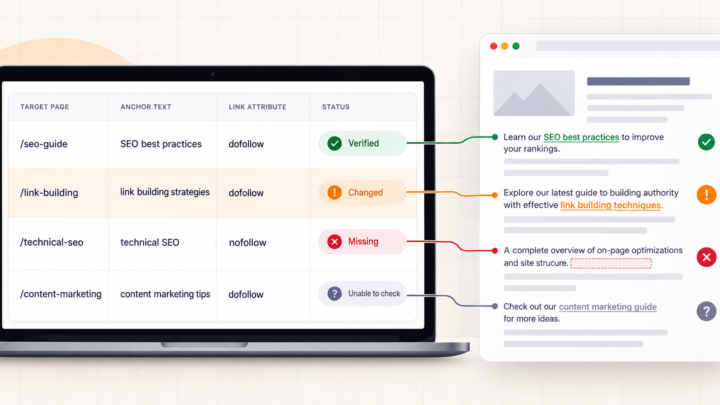
| Placement verification | Recheck known source URLs for the link, destination, anchor, attributes and page response | What an unexpected or unreadable result means and what action is proportionate |
This is also why the “all-in-one” label can be misleading. A platform may cover every row in the table, but coverage does not prove that its prospects are relevant, its contact is the right editor or its drafted email contains a real reason to reply.
Where automation crosses into link spam
Google’s spam policies for web search list using automated programs or services to create links as link spam. The same section includes excessive link exchanges, paid links that pass ranking credit and low-quality links placed in comments, directories or widely distributed content.
The important word is create. Collecting candidate pages, verifying contact data or scheduling an email does not place a link on somebody else’s site. Auto-submitting comments, profiles, directory entries or spun posts does. Adding AI to the second process does not change what the process is doing.
- Workflow automation helps a person research, communicate, record and verify.
- Placement automation creates or arranges links without meaningful editorial choice.
That is a policy boundary, not a promise that any outreach workflow is automatically good. Google’s guidance on third-party SEO tools also says that Google does not evaluate or approve these services and that they cannot guarantee performance. A tool can make an inefficient campaign faster. It can make a bad campaign faster too, which is less of a feature than the sales page may suggest.
Choose a tool for the bottleneck you actually have
Do not buy the longest feature list. Start with the point where your current process is losing time or quality. The site’s broader guide to link prospecting tools maps the whole stack; the choices below focus only on automation.
If you do not have enough candidate pages
Use a research index first. Ahrefs Content Explorer is documented for finding topic-relevant pages, unlinked mentions and broken-link prospects. Semrush’s Link Building Tool combines prospect discovery with outreach and campaign tracking.
These tools can make a large list quickly. That is their strength, not proof that every row belongs in a campaign. Export by page where possible, deduplicate at host level and open the priority URLs before anybody writes to them.
If the list is large but most pages are unusable
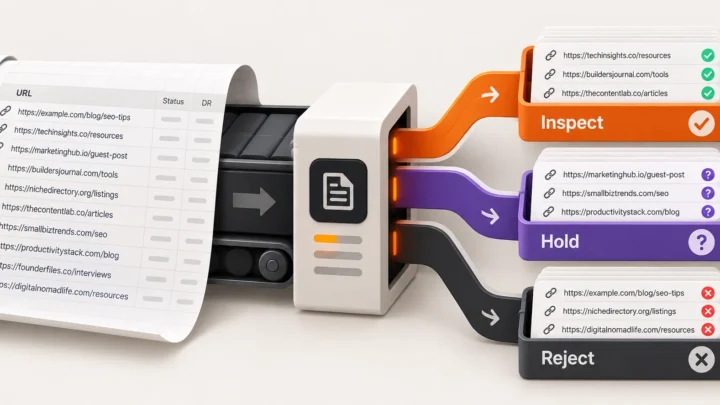
Automate the cheapest factual checks before asking a person to read everything. Can the exact page be reached? Is it the page type you expected? Is the opportunity still available? What evidence is visible now? Then reserve human time for topical fit, editorial quality and the value of the proposed placement. The full prospect-vetting sequence follows that order.
If finding and checking contacts takes the afternoon
A contact tool such as Hunter can find public professional addresses and return a verification status. Its own verification documentation includes valid, invalid, accept-all and unknown states, and notes that verification is never certain forever. Keep the status and date, but still confirm that the person has the right role. A deliverable address for the wrong employee is a very efficient way to reach the wrong employee.
If follow-ups and conversations are getting lost
Use an outreach CRM or sequencer. BuzzStream documents prospect research, relationship history, email and campaign reporting in one workspace. Pitchbox supports site review, personalization fields and automated follow-up sequences, while Semrush can manage outreach inside its Link Building Tool.
The automation should begin after approval, not instead of it. Preview the first message for every new segment, stop on replies and opt-outs, and make sure a person owns the conversation once the recipient responds. If a campaign is already getting silence, diagnose delivery, page fit, contact choice and the offer before increasing volume.
If placements are live but nobody rechecks them
Use a monitor or direct verifier for source URLs you already know. It should preserve the source, expected target, anchor, link attributes, check time and an honest unreadable state. The comparison of backlink monitoring tools explains when a discovery index, placement monitor or spreadsheet is the better fit.
Test automation on the same 30 prospects
Feature pages tell you what a product is designed to do. A controlled small batch tells you how much work it saves in your campaign. Take 30 representative prospects and run the same input through each shortlisted tool, while keeping your current manual process as the baseline.
- Count usable pages after human review. A thousand discovered domains are not valuable if the relevant-page rate is poor.
- Check contact accuracy. Record whether the address is deliverable and whether the person can influence the page.
- Measure editing time. A generated pitch that needs a full rewrite has not automated much.
- Review replies by quality. Separate positive editorial conversations from prices, exchanges, removals and automatic responses.
- Verify any resulting placements. Record the actual source, destination and attributes rather than treating “won” in a CRM as proof.

Also record the time a person spent approving prospects and messages. That is the cost automation pages tend to misplace. Scale only after the tool improves a useful outcome, such as qualified prospects per hour or relevant positive replies, without increasing obvious mismatches.
Warning signs in an automated link building tool
- It promises a number of backlinks or a ranking result instead of documenting a workflow.
- It places comments, profiles, directory entries or articles automatically on third-party sites.
- It offers no preview or approval step before the first message is sent.
- Its prospect score is a black box, or it treats a domain metric as proof of page relevance.
- It cannot show where contact data, page claims or personalization details came from.
- It counts sends, discovered domains or open rates as success while hiding replies and verified placements.
The practical verdict
There is no best fully automated link building tool because earning a worthwhile link includes decisions software cannot own. Use Ahrefs or Semrush when discovery is the bottleneck, a page-level checker when the raw list is the problem, Hunter when contact work is slow, and BuzzStream, Pitchbox or Semrush when campaign coordination is falling apart. Add monitoring after placements exist.
Start with one stage, keep the human approval gates visible and test on a small shared list. If a product saves clicks while improving the number of relevant conversations, it is useful automation. If its main promise is that links appear without judgement, the convenience is the warning.