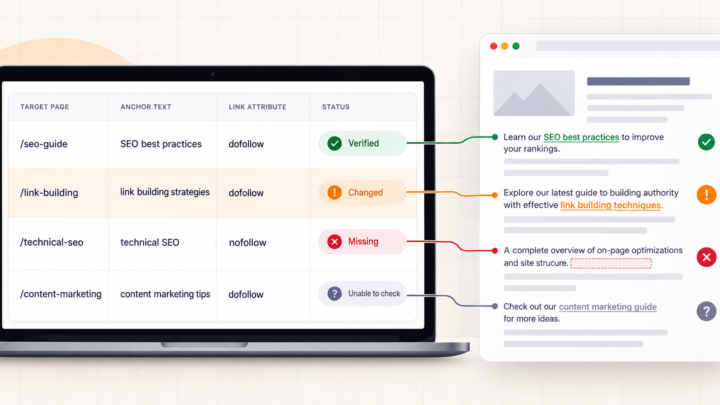


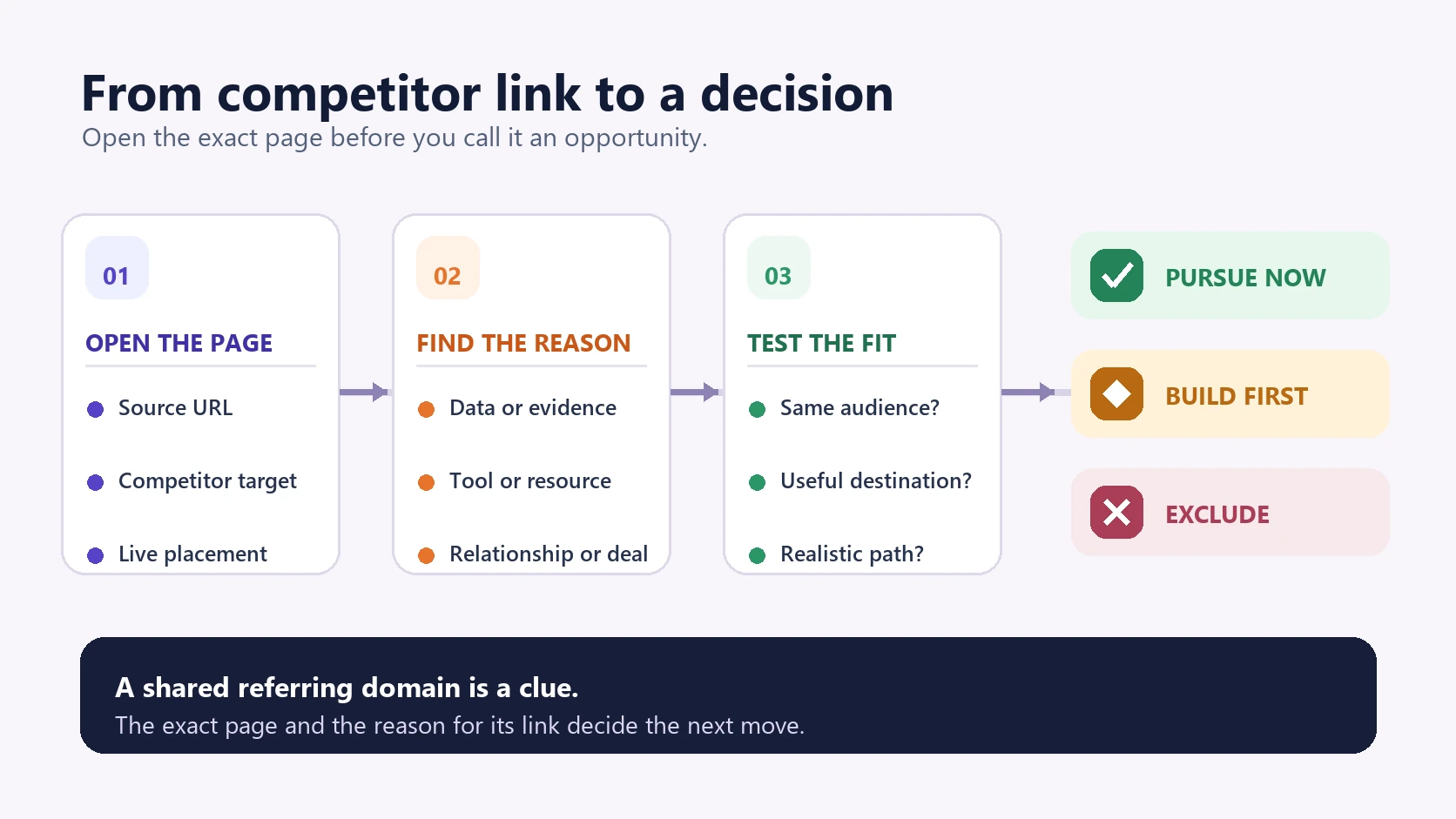
A backlink gap analysis finds websites or pages that link to your search competitors but do not link to you. The export can reveal useful prospects, but every missing link is not an opportunity. Before outreach, open the exact referring page and answer two questions: why did it link to the competitor, and can your page earn the same editorial reason?
That distinction keeps a promising report from becoming a very long list of strangers. A competitor may have earned a citation with original data, a useful tool, an old partnership, a paid sponsorship or a founder interview. Those links appear together in the same export even though they require completely different next steps.
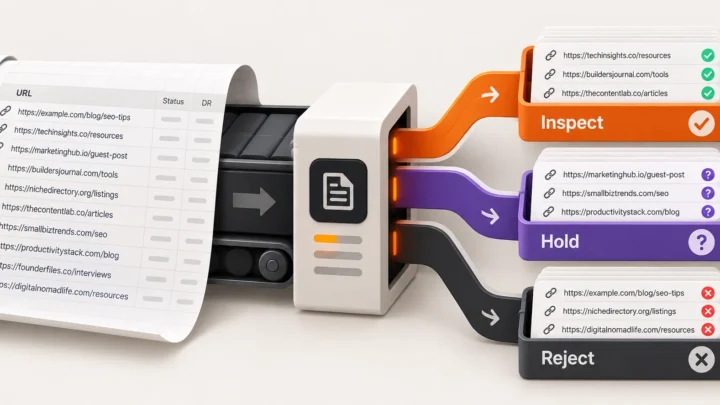
The useful outcome is a short queue with three decisions: pursue the page now, build the missing asset first or exclude the row.
Start with the page you want to improve
A domain-wide comparison can show broad patterns. It can also mix links to a competitor’s homepage, free tools, research, careers section and ten-year-old press coverage. That does not tell you what could support the page you are trying to grow.
Choose one target page or topic first. Search its main query and identify the pages that repeatedly compete with it. These are search competitors for this task. They may differ from the companies your sales team considers business rivals.
- Use several comparable competitors. One profile shows what happened to one business. Repeated patterns across three or four relevant competitors are more useful clues.
- Avoid impossible comparisons. A new specialist site will learn little from a media giant whose links come from decades of news coverage, acquisitions and offline relationships.
- Match page type and intent. Compare a product page with competing product pages, or a research asset with other resources answering the same question.
This gives the analysis a practical boundary. You are looking for links that could make sense for a specific destination, not trying to recreate another company’s entire history.
Pull referring pages, not only domain names
Backlink gap tools usually begin with referring domains. Semrush describes its Backlink Gap tool as a comparison of your site with up to five competitors. Ahrefs’ backlink gap workflow similarly starts with domains and later switches to exact referring pages.
Keep the domain-level overlap, but preserve page-level evidence in your working file:
- referring domain and exact source URL;
- competitor destination URL;
- anchor text and surrounding section;
- observed link attributes and placement;
- which competitors received a link;
- the tool and export date.
If you use Ahrefs, the site’s Ahrefs export workflow explains why page rows are more useful than a list containing only domains. No third-party index is complete, so treat the export as a dated research sample rather than a record of everything on the web.
Find the reason before you score the prospect
Competitor overlap tells you that a site has linked within your market. It does not explain the editorial decision. Open the source page and classify the reason before sorting by DR, traffic estimates or follow status.
| Why the competitor received the link | What to investigate | Likely next step |
|---|---|---|
| Original data or expert evidence | Which claim needed support and whether your evidence answers the same question | Build or improve the evidence before pitching |
| Useful tool, template or reference | What job the resource performs and whether yours serves the page’s readers as well | Pursue when the fit is direct and demonstrable |
| Roundup or resource list | Published inclusion criteria, freshness and whether the editor still maintains the page | Request consideration with a specific reason |
| Guest contribution or author bio | Whether the publication still accepts contributors and what editorial value they require | Follow the current contribution route, if one exists |
| Interview, event or partnership | The relationship or event that made the mention relevant | Usually treat as insight, not a link to copy |
| Paid or sponsored placement | Disclosure, attributes, audience and advertising terms | Evaluate separately as a commercial placement |
| Scraper, profile or repeated template | Whether a person made an editorial choice and whether the page serves readers | Exclude from the active outreach queue |
A high domain metric does not change the reason a link exists. The Domain Rating guide explains why a useful domain-level comparison cannot replace page review.
What a 12-page gap can look like after review
Consider this synthetic example. It is designed to show the decision process, not to claim a typical conversion rate. An export contains 12 exact pages linking to at least one of three competitors.
| Observed pattern | Rows | Decision | Reason |
|---|---|---|---|
| Active resource or comparison pages serving the same audience | 3 | Pursue now | Your current page satisfies a visible inclusion need |
| Citations to a competitor’s proprietary research | 2 | Build first | You need credible evidence that gives an editor a reason to change or add a citation |
| Tool lists where your homepage does not explain the relevant use case | 2 | Build first | Create or improve the destination before asking for inclusion |
| Founder interviews and event recaps | 2 | Exclude | The relationship and event are not reusable placement routes |
| Sponsored feature | 1 | Exclude from earned outreach | It belongs in a separate advertising decision |
| Scraped profile and automated directory pages | 2 | Exclude | No useful editorial route is visible |
The numbers are less important than the transformation. A gap report measures an absence in a third-party index. Manual review converts that absence into work your team can defend.
Use an exact-page checklist before outreach
For every row that survives the reason check, inspect the current page. A domain can be relevant overall while one old article is abandoned, inaccessible or unrelated to your destination.
- Access: Does the source URL load, redirect or return an error? Keep blocked or uncertain pages unresolved.
- Audience: Would the people reading this page reasonably need your destination?
- Context: What statement or next step does the competitor link support?
- Destination: Open the competitor’s target. Do not infer its purpose from the anchor alone.
- Placement: Record whether the link is in editorial copy, a list, author box, comment, footer or template.
- Attributes: Note
nofollow,sponsored,ugcor no qualifying attribute without treating one value as a quality verdict. - Editorial path: Look for current submission criteria, an editor responsible for the section or evidence that the page is still maintained.
Google’s link best practices recommend descriptive anchor text supported by relevant context. That guidance is useful for understanding the existing link, but it does not tell you that the publisher wants another one.
Match the request to the reason the link exists
A generic “your readers may find this useful” email ignores the evidence you just collected. Use the existing page to make a specific, honest request.
- Resource page: Name the section your resource fits and the reader task it completes.
- Outdated citation: Show what changed and why your current evidence improves that particular claim.
- Comparison or roundup: Address the published criteria instead of asking to be added because a competitor appears there.
- Broken destination: Confirm the link is actually broken and offer a replacement that preserves the original reader promise.
- Contributor route: Pitch an article or contribution that belongs on the publication, not a prewritten container for your link.
If the only pitch is “you linked to them, so link to us,” the analysis has not found a reason yet. The guide to outreach with no replies explains why a weak asset or offer should be fixed before another email sequence begins.
Keep three queues and the evidence behind them
Do not hide the decision in one priority score. Keep three separate views so teammates can see what must happen next.
| Queue | Minimum evidence | Next action |
|---|---|---|
| Pursue now | Live relevant page, clear reader need, suitable destination and a current editorial route | Prepare a page-specific request and assign an owner |
| Build first | Good source and audience fit, but your evidence, tool, comparison or destination is not strong enough yet | Create the missing value, then review the source again |
| Exclude | Irrelevant, automated, relationship-specific, inaccessible after reasonable checks or outside the campaign’s ethical and commercial boundaries | Record the reason so the row is not recycled next month |
Useful columns include the source URL, competitor target, link reason, page evidence, your proposed destination, decision, decision reason, owner and last review date. The broader prospect-vetting guide provides additional rejection criteria when a row needs deeper manual review.
Avoid the shortcuts that rebuild competitor noise
A backlink gap can shorten discovery. It cannot outsource judgment. These shortcuts usually make the list larger and less useful:
- treating every domain that links to three competitors as high priority;
- using one universal DR or estimated-traffic cutoff;
- filtering to followed links before understanding why the links exist;
- sending the same pitch to resource pages, interviews, directories and editorial articles;
- copying a paid or exchanged pattern without examining the commercial relationship;
- automating outreach before someone approves the exact page and request.
Google’s spam policies list paid links that pass ranking credit, automated link creation and certain low-value distributed links among link-spam examples. A competitor doing something does not make it useful or defensible to reproduce. The article on link-building automation shows where software can handle repetitive work while a person keeps the approval decision.
The gap is a research shortcut, not a strategy
A competitor backlink gap tells you where to look. The exact page tells you what happened. Only after you understand the audience, link reason, destination and current editorial path can you decide whether the row belongs in outreach.
Judge the analysis by how confidently it removes bad work. A shortlist of three defensible prospects and four useful asset ideas is more valuable than a thousand-row export waiting for a mail merge.