

A vendor sends a spreadsheet of websites with impressive authority scores. The offer promises permanent links, your preferred anchor text and quick publication. Before paying, you need to know what those placements actually are.
PBN backlinks come from a private blog network operated primarily to influence another site's search rankings. A professional design or high Domain Rating cannot establish that a placement is independent, useful or safe. Equally, a shared theme or low traffic estimate does not prove that a website belongs to a PBN.
The useful decision is whether the proposed placement has enough evidence to justify further consideration. You can decline an unsuitable offer without proving who owns every domain.
A real publisher can still sell an unsuitable link
A PBN concerns a network's purpose and control. A link farm concerns how sites manufacture or sell links at scale, often with little editorial value. The labels can overlap, but they are not interchangeable. A standalone website can sell indiscriminate placements without belonging to a private network. A publisher can own several legitimate publications without operating a PBN.
The commercial terms matter regardless of the label. Google's link-spam policy covers buying links for ranking purposes. Violations can lead to lower rankings or exclusion from search, including through manual actions. Finding real authors, relevant content and an audience does not make a paid link intended to pass ranking credit compliant.
Paid advertising is a different proposition. Google prefers rel="sponsored" for paid placements; nofollow is also acceptable. Evaluate those placements for audience fit and referral value, not a promised ranking boost. No inspection can guarantee how Google will treat an individual link.
Separate PBN backlink clues from proof
Keep three columns in your review: observed, inferred and unknown. The first records something you can point to. The second contains your interpretation. The third stops a guess from quietly becoming a fact.
| What you observe | What it may suggest | What it does not prove |
|---|---|---|
| Several sites share a theme, hosting provider or contact address | Shared infrastructure or management | That the sites exist to manipulate rankings |
| A site has high DR but little estimated organic traffic | A mismatch worth investigating | Zero readers, a penalty or PBN ownership |
| Unrelated commercial links repeatedly interrupt articles | Weak editorial control or link-selling behavior | Common ownership across the vendor's list |
| Archived pages show an abrupt change of subject | A change of ownership or purpose | That every current page is manipulative |
| The seller guarantees followed links with any anchor | The placement is being sold on its ranking terms | That the links will improve rankings |
These are review prompts, not a scoring formula. Three weak clues do not automatically become proof.
Inspect the placement before the domain score
Start with the exact page and surrounding links
For an insertion, request the proposed source URL and the paragraph where your link would appear. For a new article, request the publication, topic, editorial requirements and comparable recent posts. A homepage alone is not a placement sample.
Read the page as someone who arrived for its stated subject. Does the destination help that reader? Do nearby links support the explanation, or jump into unrelated commercial offers? Browse several recent posts and older examples yourself, rather than relying entirely on the seller's selection.
Count links only when the count answers a question. A reference page can legitimately contain many citations. One irrelevant commercial insertion can be enough to reject a particular placement. There is no useful universal rule that a certain number of outbound links makes a page a farm.
If the offer is an insertion into existing content, the niche-edit review explains the page-level checks in more detail.
Check whether the publication's story holds together
Compare its stated subject, recent articles, author information and editorial contact. Follow an author's profile and inspect whether the claimed work is visible. Look for specific editorial decisions, not merely an About page that exists.
When the current subject seems disconnected from the domain's history, inspect available archived versions. Record the dates and the change you found. An archive gap is missing evidence, not evidence that something suspicious happened during that gap.
Treat shared ownership separately from publishing quality. A media group can reuse infrastructure across useful publications. Conversely, different designs do not demonstrate independence. Write down the inconsistency you need explained instead of labelling the entire network.
Use traffic and authority as questions to investigate
Ahrefs defines Domain Rating as a relative measure of backlink-profile strength. It is not an editorial-quality certificate. The WebDiagnosis explanation of why DR is not enough shows why the metric cannot make the placement decision for you.
Inspect which pages and queries account for a site's estimated search visibility. Check that the country, language and topics fit your audience. A relevant publication with modest visibility may be more useful to your readers than a larger site ranking for unrelated subjects.
Semrush's organic traffic figures are estimates, not access to a publisher's analytics. Record the tool, database and check date. A low estimate does not establish that nobody visits; a falling chart does not diagnose a Google penalty.
A worked example: enough evidence to decline
Consider this fictional offer, not a tested publisher: an article insertion on a gardening website. The vendor describes it as a real publication and supplies a high DR score.
Your review produces this record:
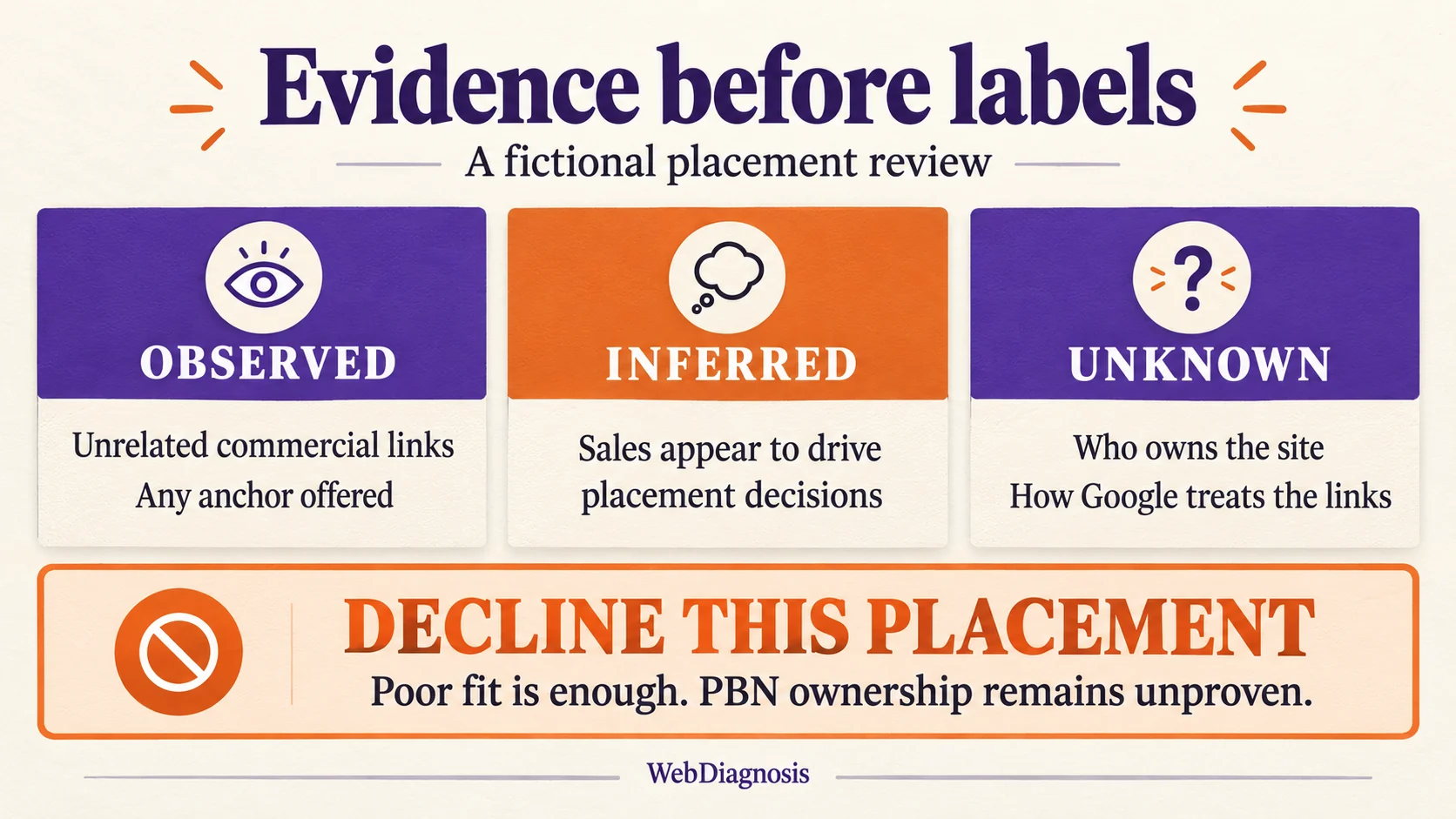
- Observed: the proposed composting article includes unrelated casino and payday-loan links. The seller offers any anchor text and guarantees a followed link.
- Inferred: the placement appears driven by link sales rather than the needs of a gardening reader.
- Unknown: the owner, any connection to other offered sites and Google's treatment of those links.
Decision: decline the placement. The unsuitable context and sales terms already answer the buying question. You do not need to turn “unknown owner” into “confirmed PBN.”
Now change the facts. A gardening publication shares a theme with another site but offers a relevant, clearly disclosed sponsored placement subject to editorial review. The shared theme alone is not a reason to accuse it of running a PBN. Ask for audience evidence and assess the advertising value before considering payment.
Ask questions that can change your decision
Send the seller specific questions tied to the proposed placement:
- Which exact page will carry the link, or who approves the topic for a new article?
- Can the editor reject the destination, anchor or insertion when it does not help readers?
- How will the paid relationship be disclosed, and which link attributes will be used?
- What evidence supports the claimed audience, with the date range and traffic source identified?
- What happens if the page is removed, redirected or materially changed?
A clear answer is something to verify, not automatic approval. An unresolved, decision-critical question means the placement stays on hold. A refusal to share private analytics does not prove fraud, but it may leave you without enough evidence to justify the spend.
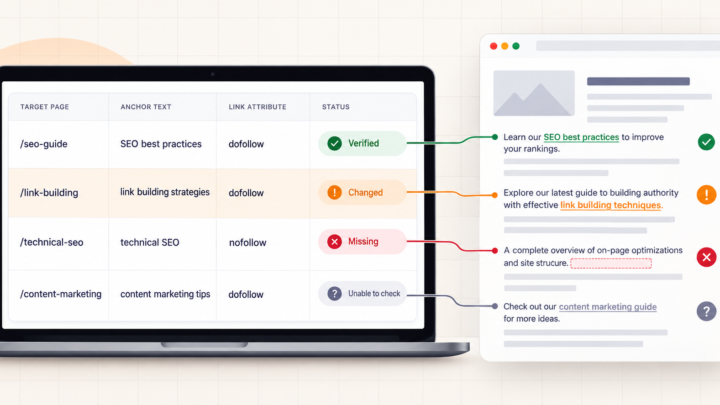
Keep the exact URL, check date, supporting evidence, unanswered question and decision in your sheet. If a suitable placement later goes live, WebDiagnosis Backlink Verifier can check supplied source pages for the expected link, anchor and observed attributes. It cannot establish PBN ownership or certify ranking safety.
Already paid and now worried about existing links? Use the separate toxic-backlink review before making cleanup decisions. A pre-purchase rejection checklist is not a disavow list.