
A Semrush backlink export tells you where a competitor already has links. It does not tell you which source pages are suitable for your campaign, whether the same placement is available to you or whether anyone should contact the site.
Treat the export as a discovery file. Keep the page-level evidence Semrush gives you, remove rows that cannot support your tactic, then send only the uncertain but plausible pages into manual or automated review. The result should be a smaller qualification queue, not a larger outreach list.
Export backlink rows, not only referring domains
For page-level prospecting, begin in Backlink Analytics, enter the competitor or target domain, and open the Backlinks tab. The current table includes Source page Title and URL, Page AS, external and internal link counts, Anchor and Target URL, First Seen and Last Seen.
Choose the scope before exporting:
- Use Active when you want links that Semrush currently treats as live.
- Use New when recent placements are more useful to your campaign.
- Apply Follow, Nofollow, Sponsored or UGC filters only when the existing attribute is relevant to the question you are asking.
- Use Add filter for details such as referring domain, anchor, link type or sitewide placement.
- Click Export above the table and save the filtered rows as CSV or Excel.
Semrush's current Backlinks report documentation confirms that the export follows the filters applied to the table. Filtering first saves rows, but avoid filtering so aggressively that you remove useful evidence. A competitor's followed editorial mention and a nofollow comment can both teach you something, even though they support different tactics.
The Referring Domains report is useful for comparing websites. It is a poor final input for exact-page qualification because it removes the page where the link was found. Keep the Source page URL.
Keep the fields that explain each backlink
Do not reduce the CSV to URL and Authority Score. The surrounding fields help you decide why the link exists and whether the pattern can be repeated.
| Semrush field | Keep it for | What it cannot prove |
|---|---|---|
| Source page Title and URL | The exact page to inspect and a quick relevance clue | That the page is still readable or open to your tactic |
| Page AS | A rough comparison between source pages | Editorial quality, audience fit or placement availability |
| Ext. Links and Int. Links | A prompt to inspect unusually crowded or isolated pages | Spam, quality or risk by itself |
| Anchor and Target URL | The destination, wording and likely reason for the existing link | That the publisher will give you the same placement |
| First Seen and Last Seen | Recency inside Semrush's index | The publication date or a guaranteed live status today |
| Link type, status and attributes | Whether the observed link is text, image, new, lost, follow, nofollow, sponsored or UGC | What a future link from that page would carry |
Keep the original export unchanged in one tab. Work in a copy so you can recover a field after discovering that it answers a question you did not expect.
Clean the export before opening pages
Start with mechanical decisions. They are quick, reversible and cheaper than asking a researcher to inspect every row.
Normalize the source URLs. Remove fragments and obvious tracking parameters, standardize host casing and flag session-like URLs. Do not strip a query string when it selects the actual article or language version.
Deduplicate carefully. Remove true duplicates, but do not collapse every row from the same domain. One source page may link to several competitor targets, and those targets can reveal whether the relationship is editorial, commercial, navigational or sitewide.
Group by host. Repeated pages from one website belong to one publishing relationship. Keep representative exact pages and park the rest. If the same anchor and target repeat across templates, record the pattern rather than treating each row as an independent opportunity. The guide to thousands of backlinks from one website explains how repeated placements inflate backlink totals.
Remove obvious mismatches. Exclude unsupported languages, irrelevant markets, login pages, search results, tag archives and page types your tactic cannot use. Keep borderline rows in a hold queue instead of inventing certainty from a URL pattern.
Name the likely placement type. A resource-page citation, product mention, author bio, directory listing and blog comment require different next steps. The fact that all five appear in the same export does not make them one outreach campaign.
Build three queues, each with a reason
A useful spreadsheet ends with decisions that another person can understand.
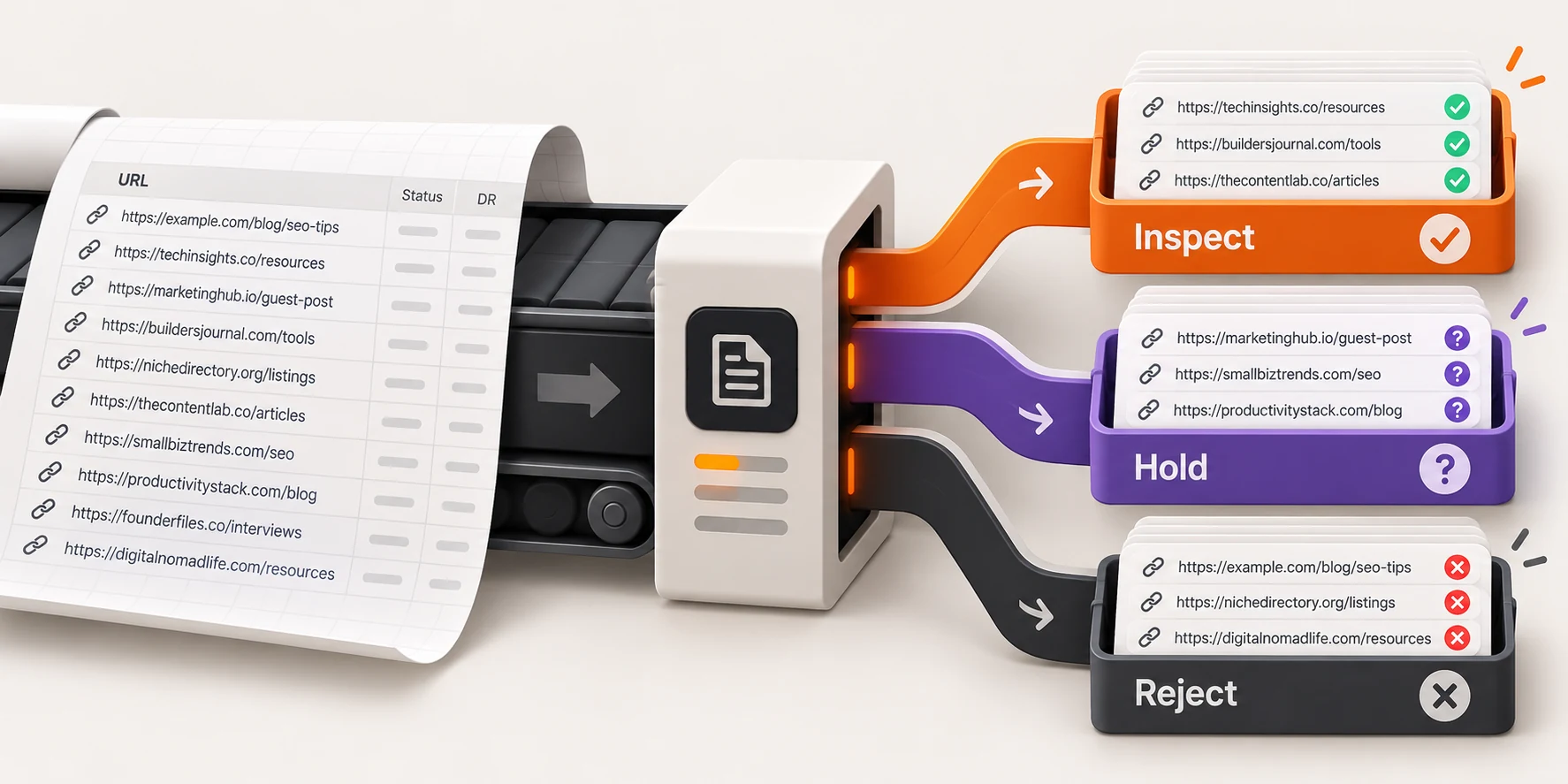
| Queue | Put a row here when | Next action |
|---|---|---|
| Inspect now | The page is relevant, the likely placement type fits and the source URL is usable | Open the exact page and verify the opportunity |
| Hold | The row may fit, but a critical fact is missing or the relationship is unclear | Record the question and assign a specific check |
| Reject | The language, market, page type, topic or placement reason does not fit | Keep the rejection reason and stop spending time on it |
Do not create a vague “maybe” sheet. A hold row needs a question such as “Is this an open resource page?” or “Was the competitor mentioned because of original research?” Without a question, the row will be reviewed repeatedly and never move.
Do not let Authority Score make the decision
Semrush describes Authority Score as its measure of a URL or domain's backlink strength. That makes it useful context, not a publisher-quality certificate. A high score cannot show whether an editor accepts contributions, whether a page serves your audience or why the competitor earned the link.
The same limit applies to link attributes. A Follow label describes the competitor link Semrush observed. It does not promise that your placement would be followed. A UGC label can help identify a community pattern, but you still need to check whether the page accepts new participation and whether joining it would help readers.
Use metrics after basic fit, not before it. The explanation of why Domain Rating is not enough applies to Authority Score for the same reason: a domain-level or page-level metric cannot make a campaign-specific judgement.
Inspect the exact pages in a fixed order
Open each row in the Inspect now queue and answer these questions:
- Does the source URL load, and is the content still present?
- Why does the competitor link exist on this page?
- Does that placement type match the campaign you can actually run?
- Is the page relevant, maintained and useful to the audience you want to reach?
- What concrete next step follows: comment, pitch, partnership research, content creation or rejection?
The existing backlink gap analysis workflow goes deeper on the most important distinction: a link can exist because of a relationship or asset you do not have. Copying the row does not copy the reason it was earned.
If your queue contains blog-comment prospects, WebDiagnosis Backlink Prospect Checker can open the exact source URLs in bulk. It reports whether a comment form is open, what link type the page evidence suggests, Ahrefs DR and comment spam risk. It reads only. It does not post, sign in or attempt a CAPTCHA, and it reports Unknown when the page does not provide enough link evidence.
That scope matters. The checker can reduce manual opening for comment-link research. It does not qualify guest-post, digital PR, directory or partnership opportunities. Those rows still need the tactic-specific review above. You can inspect the sample report before using the tool.
Hand a decision queue to outreach, not a raw export
Before anybody writes an email, keep these columns together: Source URL, host, competitor target, observed anchor and attributes, likely placement type, decision, reason, owner, check date and next action.
The strongest Semrush export is not the one with the most rows. It is the one that preserves enough evidence to explain why a page entered the queue, why weak rows were removed and what the researcher should do next.
Semrush does the discovery well. Qualification begins when you stop treating every discovered backlink as the same opportunity.