

There is no universal safe number of backlinks per month. Ten new links can be a problem when they come from ten placements created only to influence rankings. Ten thousand can be ordinary when one useful report earns widespread news coverage or a single website repeats a link in its template.
A backlink-growth chart tells you that a crawler found something. It does not tell you who created the links, when they were actually added, why the sources mentioned you or whether every row represents an independent website. That makes a monthly quota reassuring, but unreliable.
If your graph jumps, inspect the source pattern before you speed up, slow down or start removing links. The aim is to explain the change with evidence, not make the line look artificially smooth.
Why a monthly backlink total can mislead you
“Link velocity” usually means how quickly a website or page appears to gain or lose backlinks over time. It is useful descriptive language. It is not a published Google score with a safe green zone and a dangerous red zone.
Before comparing one month with another, identify what your report is counting:
- Backlinks or referring domains: 500 linking pages on one website are 500 backlink rows but one referring domain.
- First seen or actually published: A tool records when its crawler found a link. The page may have existed earlier.
- Whole domain or one page: A publicity campaign can grow the homepage profile while an unrelated service page stays unchanged.
- Live or historical links: Some reports retain lost or removed links, so the displayed total may not describe the current web.
If Ahrefs, Semrush and Search Console show different totals, that does not automatically mean one is broken. They crawl and sample the web differently. The guide to different backlink counts across tools explains how to make a fair comparison.
A new-link date is not always the placement date
Semrush defines First Seen as the date its crawler first found a backlink. That is valuable for monitoring, but it is not the same as a verified publication timestamp. A crawler can discover several older pages together after reaching a new part of a site or revisiting pages it missed.
Google also describes its Search Console Links report as a sample rather than a complete link index, and notes that it can include links removed after the data was collected. Use these dates and charts as leads. Confirm important details on the source pages.
The same backlink spike can have four different causes
Suppose a tool reports 300 new backlinks this week. The number alone cannot choose the right response. These four source patterns could all create a similar-looking spike.
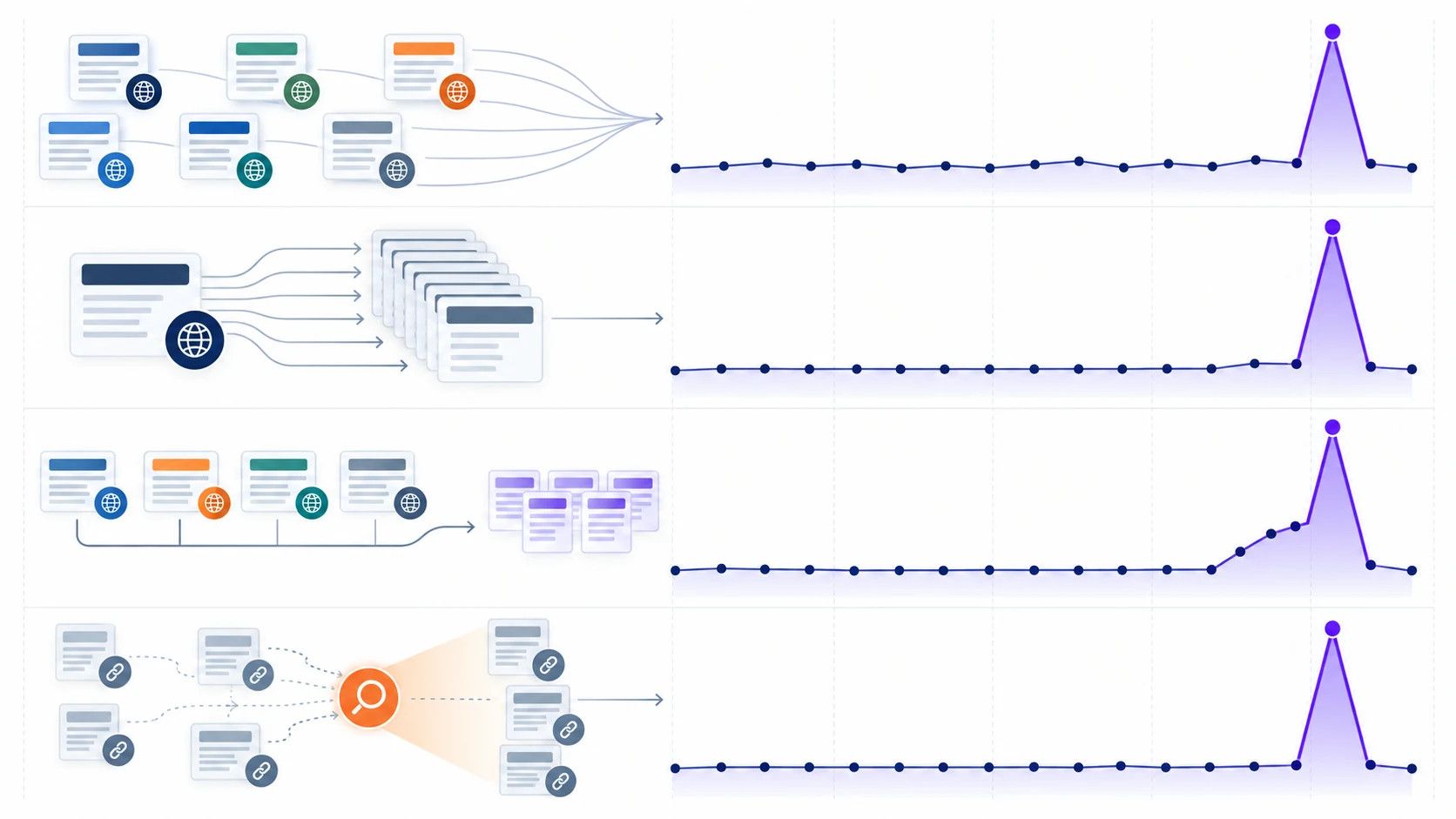
| What created the spike | What a report may show | What to check next |
|---|---|---|
| Independent editorial or news coverage | Many domains link within a short period | Confirm the sources are real, relevant and independently written |
| One sitewide template link | Hundreds of pages from one domain appear together | Group by referring domain and inspect the repeated placement |
| A coordinated placement batch | Several similar pages, anchors and destinations go live together | Review who arranged them, the agreements and whether ranking credit was the purpose |
| Delayed crawler discovery | Older pages receive the same first-seen date | Compare page dates, cached campaign records and earlier exports |
If many rows come from one website, run the sitewide-link check before treating each page as a separate endorsement. A large number may be a navigation or template decision repeated by the source site.
Audit the links behind the graph
You do not need to open every row first. Start with the domains that account for most of the increase, the links pointing to commercially important pages and any placements your team or provider controlled.
- Group new backlinks by referring domain. This separates one repeated source from many independent sources.
- Sample exact source URLs from each group. Prioritize the largest clusters and unexpected domains.
- Confirm the page and link are live. Record the source response, destination and any redirect rather than trusting an old export.
- Read the placement in context. Check whether the mention helps a reader, whether the anchor describes the destination and whether the link sits in the main copy, author bio or template.
- Record link attributes. Note
nofollow,sponsoredandugc. Use the link-attribute guide if those labels are unclear. - Identify the relationship. Separate earned mentions from links you bought, exchanged, required, placed yourself or received without asking.
- Compare dates with campaign records. A first-seen date becomes more useful when matched with publication dates, outreach logs and previous exports.
The result should be an evidence table, not a vague “looks natural” judgment. Record the source URL, referring domain, live status, target, anchor, attributes, placement, relationship, first-seen date, visible publication date and review date. The link-building report checklist shows what to request when an agency or freelancer delivered the work.
What Google says about rapid link growth
Google does not publish a monthly backlink quota or describe “link velocity” as a standalone pass-or-fail factor. Its link-spam policy focuses on methods and purpose. Examples include buying links that pass ranking credit, using automated programs to create links, excessive exchanges and distributing links with optimized anchors mainly to manipulate rankings.
This is why slowing a questionable campaign from 100 placements a month to 20 does not fix the underlying method. It only spreads the same decision over a longer period. Likewise, a genuine burst of independent coverage does not become suspicious merely because it arrived quickly.
Choose the response from the cause
If the spike came from earned coverage
Document the campaign or event, preserve the strongest source examples and check that the links reach the intended pages. There is no practical reason to ask independent publishers to delay useful coverage so a chart looks tidier.
If one domain repeated a link
Treat it as one referring-domain relationship during analysis. Inspect where the link appears, who controls the template, whether the destination is useful and whether the placement was part of a commercial arrangement. Fix a broken or misleading implementation at its source instead of reacting to every duplicate row.
If a provider created a coordinated batch
Review the controlled placements before ordering another batch. Repeated page formats, forced commercial anchors, unrelated sources and undisclosed paid links deserve attention. Do not drip-feed the same pattern merely to make it appear organic. Change the method and approval process.
If the links appeared without your involvement
Confirm the sample, monitor what remains live and look for an actual impact before taking drastic action. A frightening count or third-party spam score is not proof that Google penalized the site. The guide to checking suspected toxic backlinks explains when deeper investigation is justified.
Should a new website build backlinks slowly?
A new site should pursue links at a pace its team can earn, review and document. That often starts modestly because a new business has fewer relationships, useful assets and publicity opportunities. This is an operational reality, not evidence of a Google-approved monthly ceiling.
Choose activities that make sense even if nobody promises a ranking increase: publish a resource worth citing, contribute real expertise, make original data understandable, build relevant partnerships and earn coverage when the business does something newsworthy. If an opportunity would be hard to explain to a customer without mentioning rankings, review it carefully.
A steady budget can help your team maintain quality and follow up properly. It does not turn a numeric pace into a safety rule. Review capacity should limit the campaign before a made-up velocity formula does.
A monitoring routine that gives the chart context
Keep the routine simple enough to repeat. Weekly checks may suit an active campaign or publicity launch; a quieter site may only need a monthly review.
- Save an export with the tool, filters, selected index and date.
- Compare both new backlinks and new referring domains.
- Investigate the domains responsible for most of the change.
- Recheck important source pages and record links that disappeared or changed.
- Add campaign, launch and publicity notes beside the graph so future reviewers know what happened.
If ongoing checks are becoming a spreadsheet chore, compare backlink monitoring tools by their alerts, historical evidence, export quality and ability to support source-page verification. A useful tool should help you investigate changes, not simply make the biggest number blink.
The practical answer
No fixed number of backlinks per month is safe for every website. The same spike can represent strong independent coverage, one repeated template link, a coordinated campaign or a crawler finding older pages at once.
Count referring domains as well as backlink rows. Treat first-seen dates as discovery evidence. Open the important source pages, record who controlled the placements and choose the response from the cause. That process will not give you a neat universal quota, but it will give you something more useful: a decision you can explain and verify.